


Nine top tech companies have $3 trillion in off-balance-sheet commitments mostly related to AI. Meta's $27 billion Hyperion data center sits off its balance sheet. Nvidia cut its OpenAI Ohio backstop from $250 billion to less than $120 billion after investor pushback. Anthropic is projecting $190-200 billion in 2028 revenue. Jane Street took a $15 billion July loss on the AI selloff.
Three trillion.
That is the off-balance-sheet commitment total at nine top tech companies, mostly tied to AI, from a WSJ review of footnotes in their latest filings. Those obligations are growing faster than reported capex, which ran about $600 billion over the past year. The total is roughly triple what the same companies owe on their leases and long-term borrowings combined.
Big Tech carries $3 trillion in off-balance-sheet AI commitments. Purchase commitments alone total $1.9 trillion.
Alphabet's (GOOGL) commitments hit $811 billion at June 30. Three months earlier they were $332 billion.
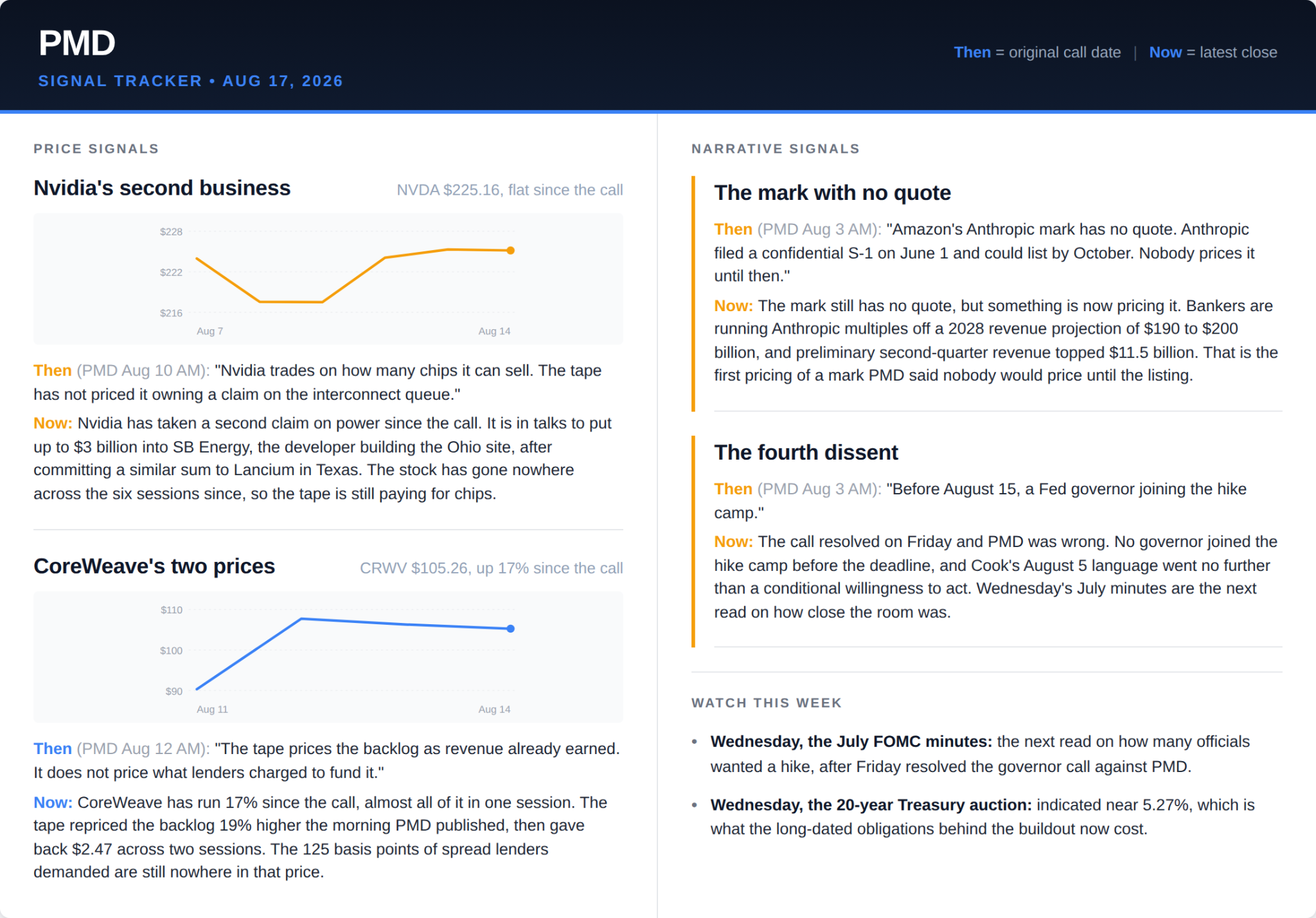
Nvidia (NVDA) cut its OpenAI Ohio guarantee to under $120 billion. The plan had been $250 billion.
Anthropic projects $190 to $200 billion of 2028 revenue.
Jane Street lost $15 billion in July. It is still ahead of last year.
PMD LENS
Fink named the 1970s mortgage-bond comparison Tuesday afternoon. This morning WSJ names the $3 trillion of off-balance-sheet promises that comparison lives inside. Every new asset class the coordinated platform wants to finance rests on obligations already made. The pushback that cut Nvidia's backstop below $120 billion is the earliest documented resistance at the guarantee layer.
Watch What the Institutions Are Doing — Not What They're Saying.
Bank of America increased its stake in one small gold company by 139%.
Jane Street — one of the most sophisticated trading firms alive — by 159%.
Millennium by 122%.
One value fund, Kopernik Global, made it their single largest holding — owning roughly 8% of the entire company.
The company doesn't even mine. It owns the rights to an 88 million ounce deposit — one of the largest on earth — with government-built roads, power already running to the property, and permits that never expire.
Market cap: ~$4 billion. Value of the metal in the ground at today's prices: hundreds of billions.
The institutions did this math quietly, over months.
You get to do it this afternoon.
- Blue Owl Capital (OWL) funds own 80% of the venture that owns Hyperion. Meta (META) owns 20%.
- Alphabet has hired banks for its debut Australian dollar bonds. It has already issued in five other currencies since January.
- Stripe bought OpenRouter for over $7 billion.
- Alphabet ran negative free cash flow last quarter. Amazon (AMZN) has run negative for a full year.
- The Strategic Petroleum Reserve fell under 300 million barrels, the lowest since the early 1980s.
Big Tech Has $3 Trillion in Off-Balance-Sheet AI Commitments. That Is Three Times What They Owe Under Their Outstanding Leases and Long-Term Borrowings Combined.
The Footnote
Nine companies have promised about $3 trillion they do not carry as debt. Alphabet, Amazon, Meta, Microsoft (MSFT), Oracle (ORCL), Nvidia, Broadcom (AVGO), SpaceX (SPCX) and AMD (AMD).
Purchase orders run $1.9 trillion. Unstarted leases run $1.2 trillion, four times a year ago. At the four biggest, off-sheet is four times on-sheet.
The Structure
Meta's Hyperion campus in Louisiana covers about 1,700 football fields. Neither it nor the $27 billion behind it sits on Meta's books. Meta rents, and the rent pays bondholders.
Meta also backstops the campus value if it walks away early. None of it hits Meta's books until the rent starts in 2029. That is the rule, not a choice.
The Other End
Bondholders hold Hyperion's debt. A Blue Owl fund sits in the equity beneath them, earning rent minus interest. That is credit risk wearing a building.
The obligations last twenty years. The contracts underneath them run three to five. The mismatch is the exposure, not the gross number.
The Tenant Question
Every leverage screen these companies sit in is built from balance-sheet debt. None of them holds the $1.2 trillion of rent that has not started. Credit desks and the agencies already adjust for it. The equity multiple does not, and that is the gap. A downgrade citing unstarted leases before third-quarter earnings moves them into the cost of debt.
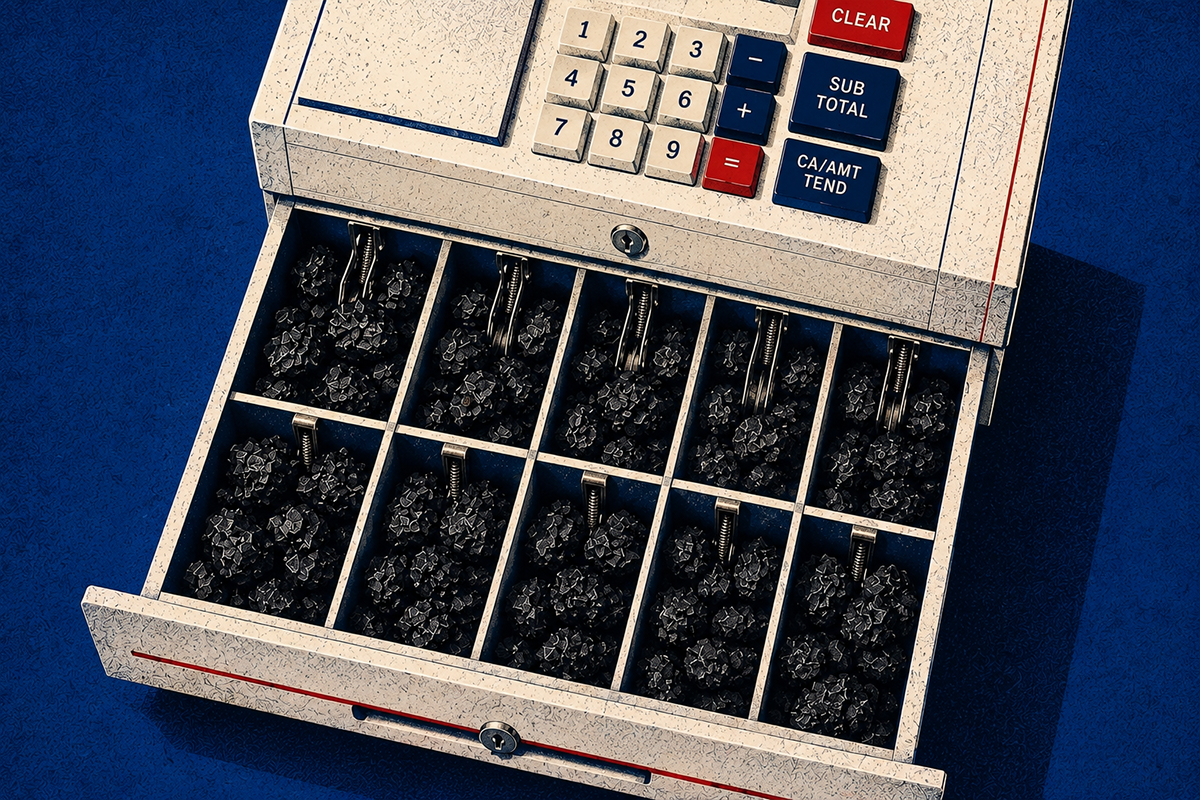
Everyone Else Burns Coal. This Company Cashes It In.
One lump of coal holds six separate commodities, and almost every company on earth just sets it on fire. Frontieras patented a way to split it apart instead.
Their process pulls diesel, jet fuel, naphtha, hydrogen, and fertilizer out of the same ton of coal, without burning any of it. One rock. Six markets totaling $2.1 trillion annually*.
Every ton of coal already has a 10-year buyer locked in, so the revenue is contracted before the plant even fully ramps up. Patents across 9 countries protect the process too, meaning no competitor can replicate and cut into that revenue once it's flowing.
Six revenue streams from one raw material means no dependence on a single commodity swinging the wrong way. Become an early-stage Frontieras investor before the opportunity closes 8/27.
This is a paid advertisement for Frontieras’s Regulation A offering. Please read the offering circular at https://invest.frontieras.com/. Forward looking statements were included here that the Company believes to be accurate given the current information. They involve known and unknown risks, uncertainties and other important factors which if changed may affect the outcome(s). Reservation of the ticker symbol is not a guarantee that we will be listed on the NASDAQ. Listing on the NASDAQ is subject to approvals. Under Regulation A+, a company has the ability to change its share price by up to 20%, without requalifying the offering with the SEC.
SIGNAL 1: The Guarantee Got Cut Before Anyone Signed
Nvidia was going to guarantee a quarter trillion dollars of somebody else's data center. Now it is guaranteeing less than half.
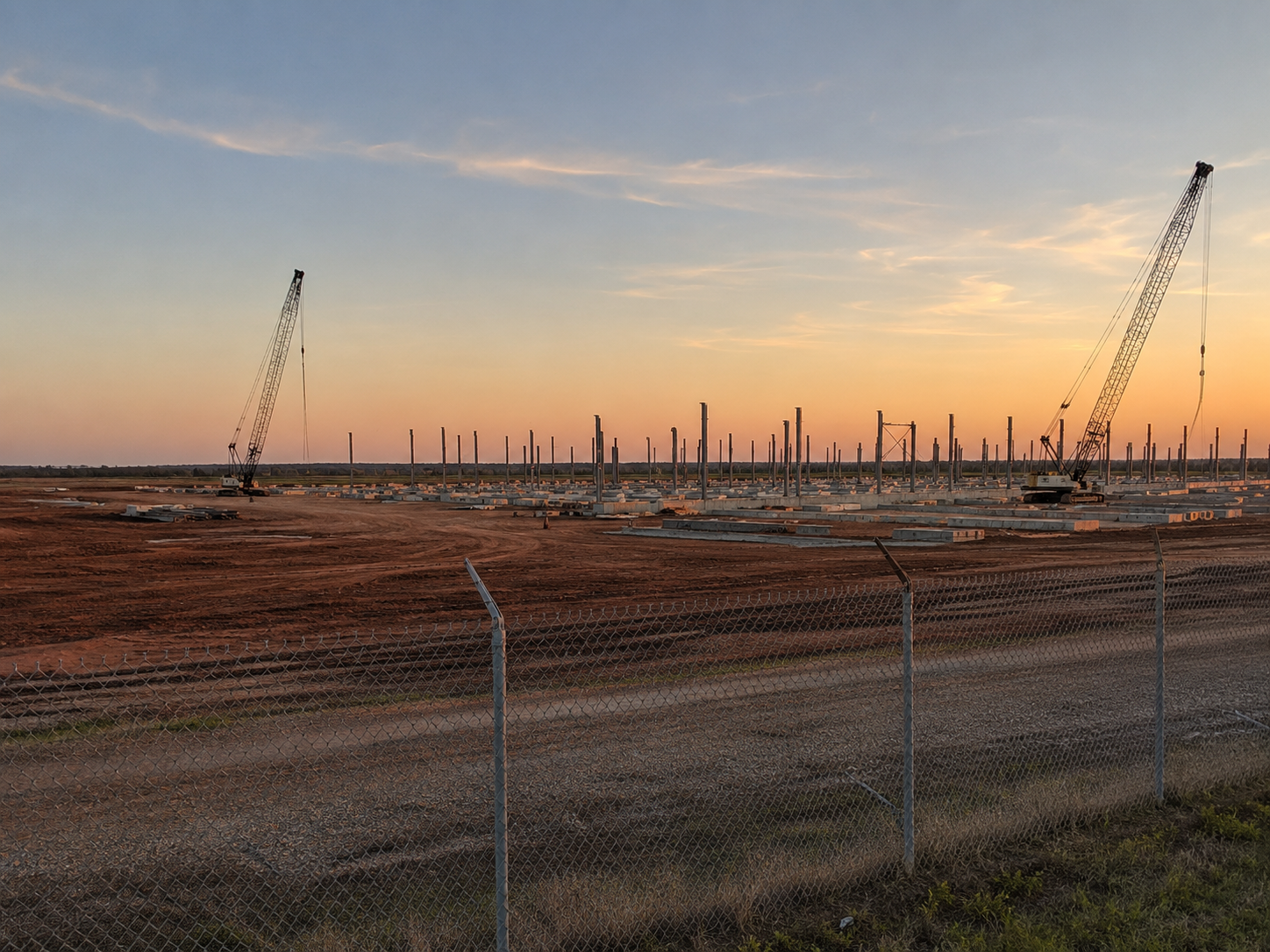
The Ohio campus with OpenAI got restructured. Nvidia backs the opening phase, roughly 5 gigawatts. Investors disliked a chipmaker underwriting its own demand.
SB Energy is building the site. It wants to list in September.
Nvidia made phase one financeable. On phase two, it kept the decision open.
The Second Phase
Nvidia's stock took the full $250 billion when it was reported. It has not re-marked the half that is now an option. The gap is a commitment against an option, and only one is priced. An SB Energy listing above $5 billion in September prices the buildout in public.
SIGNAL 2: The Multiple Moved to 2028
Bankers pricing Anthropic have stopped using this year's revenue. They are using 2028.
The company projects $190 to $200 billion for that year. Four sources say the multiples run off that number. Looking out that far is what the growth rate forces.
Second-quarter revenue topped $11.5 billion, against $787 million a year earlier. The figures are preliminary.
Palantir (PLTR) trades near 53 times a forecast that ends in December. Anthropic's ends in 2028.
The Base Year
Anthropic's valuation now rests on a 2028 forecast. Two quarters of this year stand behind it, one of them preliminary. 2027 sits inside the multiple without sitting in the disclosure. Discipline moved out of the multiple and into the projection. A third-quarter print above $15 billion makes 2028 a multiple of a run rate, not a guess.
SIGNAL 3: The Market Maker Was Also the Investor
Jane Street lost $15 billion in July. It has still made more than $40 billion since January, beating all of last year.
Reuters ties the loss to Situational Awareness, an AI fund it backed, and to other tech in the selloff. Margin calls forced that fund to sell its stock book to Citadel. Jane Street says its stake there ended the year flat.
So the damage came from the trading book, not the fund. July was its first losing month since 2016.
The Same Balance Sheet
AI concentration reads as an earnings risk at four cloud companies. Its second form sits inside the firms that make the market. Prime brokers price that. The public tape does not. A second market maker disclosing a loss above $5 billion makes it a feature.
AI CEO Issues Code Red: Prepare for Meltdown
The CEO of this AI company (click here to get the name, 100% free) just issued a CODE RED in an internal memo…
Warning his employees that they’re dealing with a critical situation.
Another company executive even implied they might need a government bailout.
And now Jim Rickards is predicting this company is about to go bust, in a full-blown AI meltdown that could be 10 times bigger than Lehman Brothers.
- Today, Empire State manufacturing and NAHB builder sentiment.
- Wednesday, the July FOMC minutes and a 20-year Treasury auction indicated near 5.27%.
- Thursday, the Philadelphia Fed index.
- Friday, the August flash PMI.
- August 27, Jackson Hole.
- September 15-16, FOMC.
Capital Discipline
A lease that has not started is still mostly a cost you cannot cancel. The occupier keeps it in a footnote. The lender treats it as the credit. In your book it arrives labelled as infrastructure yield.
Pull the position with the largest signed rent that has not started. Split its value: the contracted term, discounted at the tenant's own spread, then everything after. If the contracted term clears your hurdle, you own a lease. If most of the return sits past it, you own a re-letting bet on a purpose-built shell. Settle that before your next investment committee.
Fink named the comparison. CoreWeave (CRWV) named the middleman's balance sheet. Thursday's auction named the cost of the hold. This morning the footnotes name its size.
Three tests land before Jackson Hole. The FOMC minutes Wednesday. The 20-year auction Wednesday. The flash PMI Friday.
The open question is no longer whether the Fed can hold. It is whether anyone prices these promises before Fink's asset class starts issuing paper.
