


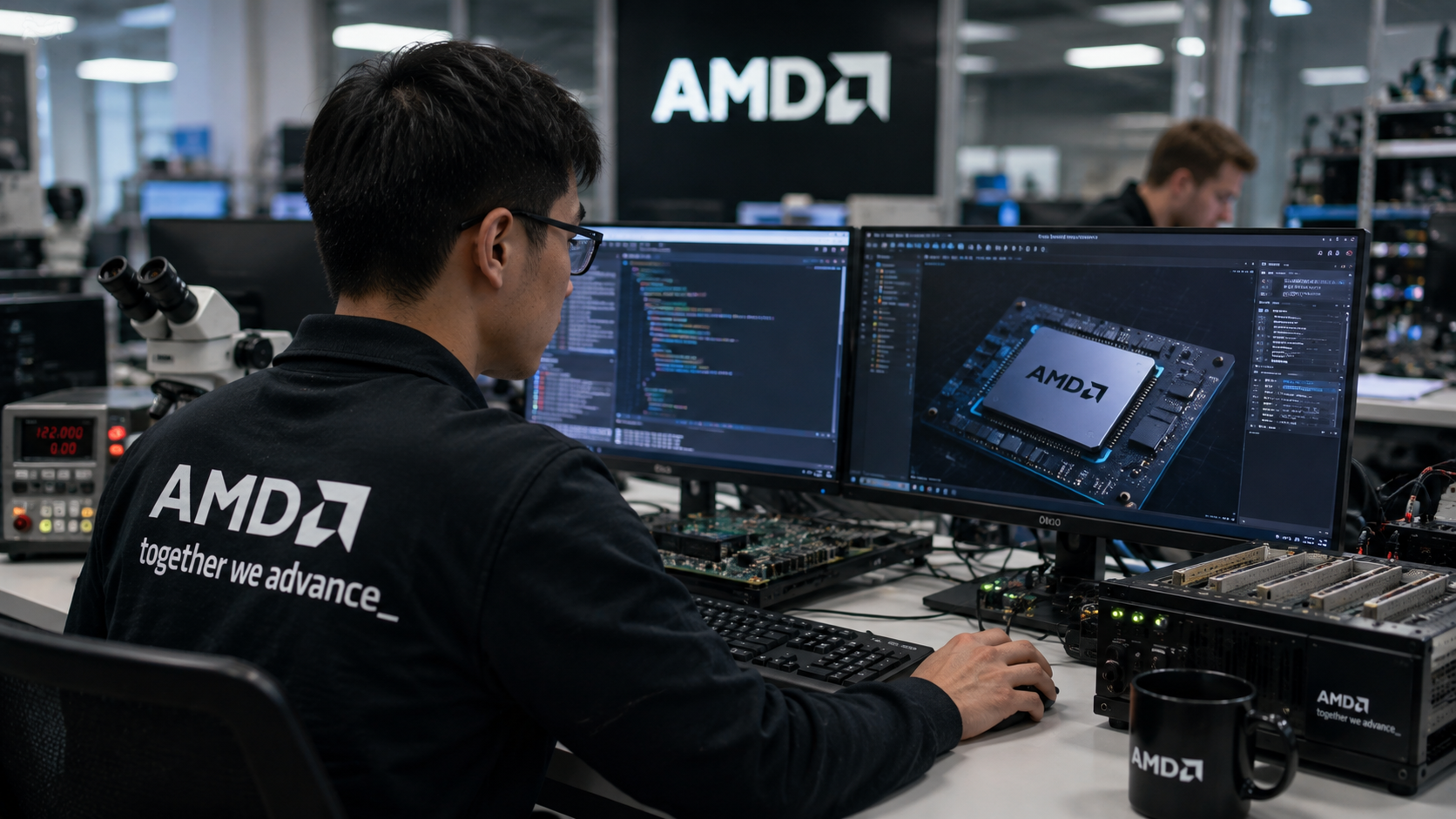
July PPI came in flat versus the 0.2% consensus. Traders moved the first rate hike to October or December. Hammack said raise rates now. AMD is raising up to $5 billion in its biggest-ever bond sale.
Two consecutive soft inflation prints. September hold odds jumped to 68%. The S&P 500 closed at a new record high.
Cisco (CSCO) fell over 8% despite a strong quarter. The semiconductor index is entering bull market territory. South Korea's Kospi gained for a second straight day.
Hammack said raise rates now anyway. AMD is raising billions in bonds for AI. A $100 billion data center IPO just emerged on the horizon. And two of the best-known short sellers from 2008 are warning on AI concentration. Everything below.
PMD LENS
Two consecutive disinflationary prints have pushed the first rate hike to October or December. Hammack still argued for immediate action. That is the composition-versus-data tension in its purest form. Jackson Hole August 27 is where Warsh has to say something. The August CPI print arrives before the September decision.
When the Fed Cuts, These Go First
The rate-cut rally is already taking shape, and our analysts just pinpointed 10 stocks most likely to lead it.
They’ve dug through every chart, sector, and earnings trend to find companies positioned for explosive upside once the Fed eases.
From AI innovators to dividend aristocrats, these are the names attracting billions in early institutional money.
Miss them now, and you’ll be chasing the rally later.
Get the Top 10 Best Stocks to Own in the Second Half of 2026 — free today before the next leg higher begins >>
PPI Came in Flat. Traders Moved the First Hike to October or December.
July PPI was unchanged for the month. Consensus was a 0.2% increase. Core PPI rose 0.2%, below the 0.3% forecast. Two consecutive months of softer-than-expected inflation data. September hold odds hit 68% from 45% a week ago.
Chris Rupkey of Fwdbonds: "Pipeline pressures at the lower stages of production are not adding to the inflation risks the consumer faces. For a second consecutive month, PPI prices have not gone up."
The market has now moved the first rate hike from September to October or December. That is a meaningful shift. It changes the rate environment every AI financing deal prices against.
But Cleveland Fed President Beth Hammack published a statement reiterating her call for an immediate rate hike. She was one of the three July dissenters. Hammack: "If we have too much growth, it could put additional pressure on prices. We need some policy restraint to get inflation from above 3% back down to 2%."
On two consecutive soft prints: "I don't have confidence we're going to see them low enough to bring us back to 2%. If it takes another three or four years to get there, is that OK?"
That is the specific tension. Two prints argue for patience. Hammack argues for action. Richmond Fed's Tom Barkin framed it as the open question of the cycle: will the Fed need to raise rates, or is inflation already on a path down without them?
Warsh speaks at Jackson Hole August 27. The August CPI print arrives before the September 15-16 decision. Both inputs are still outstanding.
The Signal to Watch
August CPI in early September is the deciding data point. Another 0.2% core confirms October or December. A 0.3% or above reopens September as a live meeting.
Iran War TRUTH:
What Was Revealed Behind Closed Doors
There’s a strategy behind the Iran war.
I know because I heard it directly in a closed-door meeting with a source whose connections run deep into global power networks.
He walked me through the real purpose and the massive deal tied to it.
SIGNAL 1: AMD Is Raising Up to $5 Billion in Its Biggest-Ever Bond Sale.
AMD (AMD) is raising up to $5 billion in investment-grade bonds. Its biggest debt offering ever. Notes in four tranches, three to ten years. Initial price talk on the longest tenor is 1.15 percentage points over Treasuries. Six major banks are managing the sale including JPMorgan (JPM), Morgan Stanley (MS), and Bank of America (BAC).
AMD recently announced agreements with Anthropic and Microsoft (MSFT) to broaden the use of its AI chips. It also committed to invest up to $5 billion in Anthropic. Anthropic buys compute from AMD. AMD invests in Anthropic. AMD borrows to fund all of it. That is the circular structure Burry and Eisman are both describing.
The Signal to Watch
AMD's final pricing above 1.15 points over Treasuries confirms borrowing costs are tightening even as rate hike odds fall. A fourth major chip company announcing a bond above $3 billion in the next 60 days confirms this is a wave, not a one-off.
SIGNAL 2: Vantage Data Centers Is Exploring a $100 Billion IPO.
Vantage Data Centers is exploring an IPO or sale as soon as next year. A listing at $100 billion would be the largest data center IPO in history. The company is backed by Silver Lake and DigitalBridge (DBRG). It recently partnered with Oracle (ORCL) and OpenAI on a Wisconsin campus tied to Stargate.
Switch has hired banks for an IPO that could raise up to $10 billion at an $80 billion valuation. CyrusOne is preparing for a potential listing as early as 2027.
The data center IPO pipeline now has three named companies at meaningful scale. All three would list into the same rate environment the Fed is navigating. The window matters.
The Signal to Watch
Any Vantage banker mandate disclosed in the next 60 days confirms a formal process is underway. Switch pricing above $80 billion confirms institutional appetite for data center equity at scale.
SIGNAL 3: Eisman and Burry Are Warning on AI Concentration.
Steve Eisman said the AI boom depends almost entirely on two companies. OpenAI and Anthropic together account for roughly 70% of AI-related revenue at Microsoft, Amazon (AMZN), Alphabet (GOOGL), and Oracle. They represent as much as 25% to 35% of those companies' cloud revenue.
Eisman: "The futures of these massive companies are a bet that OpenAI and Anthropic succeed."
His concern is the Achilles heel: if Chinese open-weight models keep taking market share and a price war starts, the revenue model breaks. Michael Burry is betting against Nvidia (NVDA) directly. He argues a significant portion of current AI demand is circular rather than organic.
Both are among the most respected short sellers of the 2008 cycle. Both are pointing to the same underlying concern.
The Signal to Watch
Any Chinese open-weight model surpassing Kimi K3 benchmarks in the next 30 days confirms the competitive threat Eisman named. Any Anthropic or OpenAI enterprise customer loss disclosed publicly converts the short-seller framing into documented market-share data.
Porter Stansberry: This Could Be Bigger Than A Stock Crash or Financial Collapse
A brutal, invisible new force is about to rip America apart… and the resulting civil unrest, political chaos, and cries for radical change will be immense. Unlike any we’ve seen in living memory.
And unless you prepare now you could see your wealth decimated in the years ahead. I shared everything you need to know about what’s coming next in my new exposé.
Two consecutive soft prints moved the first hike to October or December. Hammack said act now regardless. AMD is borrowing $5 billion to fund a circular structure linking it to Anthropic from both sides. A $100 billion data center IPO pipeline just emerged alongside Anthropic's fall listing. Eisman and Burry both named the same two-company dependency. Every framework tracked this week converges on the gap between what the data says and what the composition of the committee still wants. That gap sits alongside the gap between what the circular financing structure assumes and what the market-share data will eventually show. Both gaps get tested against the August CPI print and Jackson Hole.
Two prints argued for patience. Hammack argued for action. AMD borrowed $5 billion inside a circular structure. Vantage named a $100 billion IPO. Eisman and Burry named the two-company risk.
August CPI in early September, any Vantage banker mandate, and any Chinese model surpassing Kimi K3 are the three signals that define whether October-or-December becomes the settled path, whether the data center IPO pipeline has real institutional appetite, and whether the concentration risk Eisman named is a short-seller thesis or a documented market trend.
