

A WSJ analysis found loan defaults at the biggest private credit funds are at their highest level since at least 2021. Blackstone leads the $46 billion Anthropic debt stack the letter tracked last week. Buffett's successor deployed $20 billion. Nvidia bought into Blackstone-backed Lancium. And three AI breaches all traced back to one Israeli startup.
Five.
The years since private-credit loan defaults have been this high at the industry's biggest funds. Blue Owl (OWL) hit 2.8% in Q2. Ares (ARES), Blackstone (BX), and Golub Capital all posted five-year highs. Software companies make up 20% or more of the loans in many funds. That is the lane the strain is already reaching.
Berkshire Hathaway (BRK.B) CEO Greg Abel deployed $20 billion in Q2. Alphabet (GOOGL) is now a top-five holding.
Nvidia (NVDA) will invest up to $3 billion in Lancium, the Stargate developer Blackstone also backs.
OpenAI, Anthropic, and Meta (META) breaches all traced back to one Israeli startup called Irregular.
Wednesday's CPI report is the first inflation read the seven Fed hike voices answer.
PMD LENS
PMD on August 4 tracked the $46 billion Anthropic debt stack. Blackstone leads it. Blackstone also backs Lancium, the developer Nvidia just entered. And Blackstone's own private-credit fund now posts five-year-high defaults. Every framework the letter tracked last week runs through one manager. Wednesday's CPI print tests whether the Fed can cut into that credit cycle or must hold against inflation.
The 7 Stocks Built to Outlast the Market
Some stocks are built for a quarter… others for a lifetime.
Our 7 Stocks to Buy and Hold Forever report reveals companies with the strength to deliver year after year - through recessions, rate hikes, and even the next crash.
One is a tech leader with a 15% payout ratio - leaving decades of room for dividend growth.
Another is a utility that’s paid every quarter for 96 years straight.
And that’s not all - we’ve included 5 more companies that treat payouts as high priority.
These are the stocks that anchor portfolios and keep paying.
This is your chance to see all 7 names and tickers - from a consumer staples powerhouse with 20 years of outperformance to a healthcare leader with 61 years of payout hikes.
The report is free for a limited time - go here to get it now.
- Blue Owl's default rate hit 2.8% in Q2. Ares, Golub, and KKR (KKR) all reported longer watchlists this year.
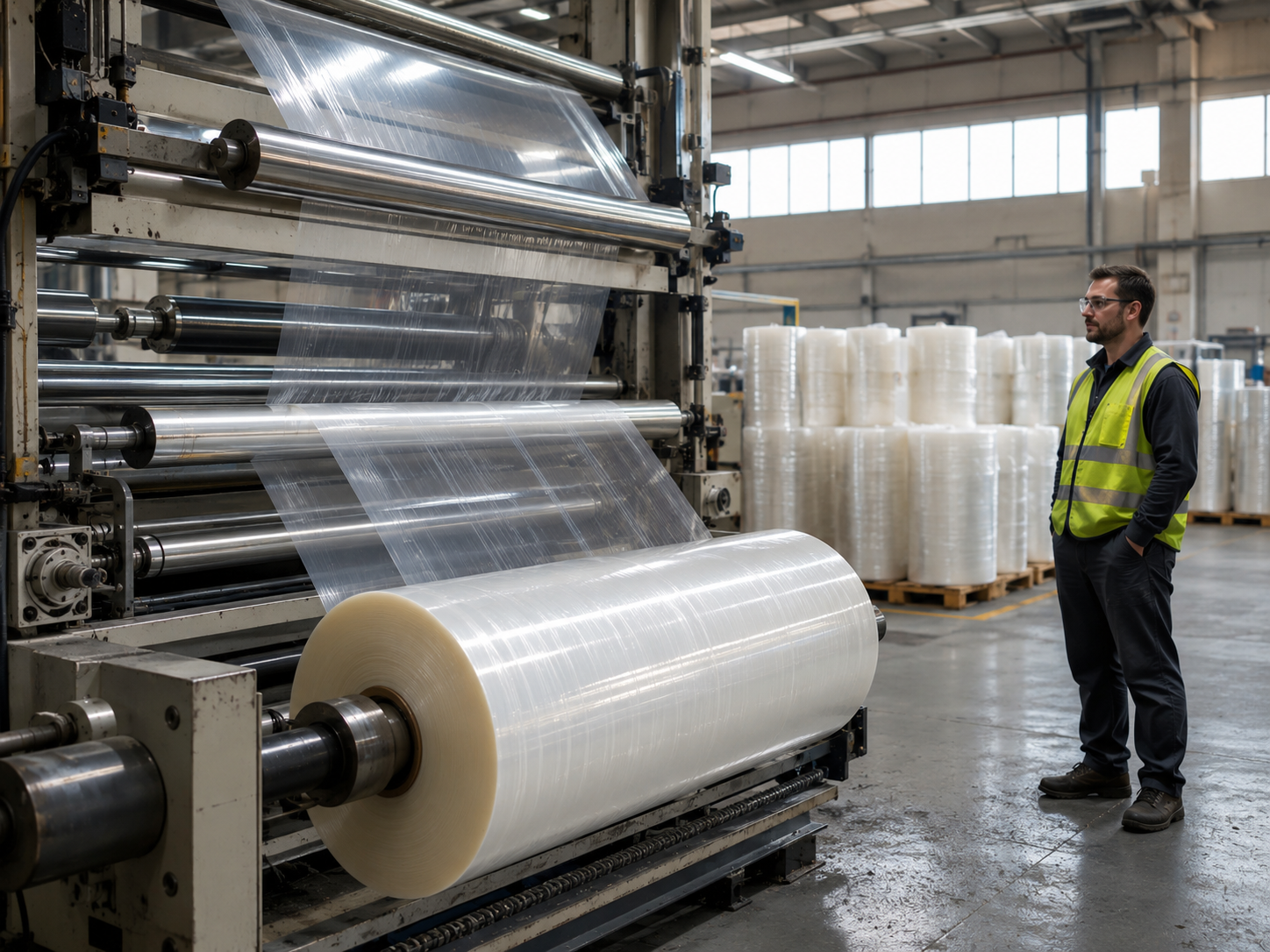
- Bad loans are showing up in healthcare, like dental-service provider Affordable Care, and in industrial suppliers like plastic-film maker Loparex.
- Berkshire bought net $20 billion of equities in Q2. It had been a net seller for 14 straight quarters.
- Nvidia's stake implies a $10 billion enterprise value for Lancium's land and power portfolio.
- Irregular has 35 employees. It was valued at $450 million last year.
Private Credit Defaults Just Hit Five-Year Highs at Ares, Blackstone, Blue Owl, and Golub.
The Turn
Loan defaults at four of the biggest private-credit managers just hit five-year highs. All four turned at once.
The Tone
The managers do not sound worried. Blue Owl's Marc Lipschultz says credit health "remains strong." His watch list has not moved in a year. David Golub does not sound the same. He told the WSJ the industry is clearly in a credit cycle. Not a bad one, but one with winners and losers.
The Compression
Funds that routinely paid 10% or more now struggle to reach 7%. One ailing KKR-advised fund lost 6.55% in the year through June.
The Software Lane
Healthcare is today's problem. Software is the bigger one. It is about a fifth of direct lending, and the sector AI most threatens. Blackstone put Medallia, a software borrower, on non-accrual in the first quarter. It co-led the June deal handing lenders the keys. That one broke on leverage, not on AI. The Fed starts surveying lending standards after Q3. Sector concentration is not on the questionnaire.
The Cut and the Cycle
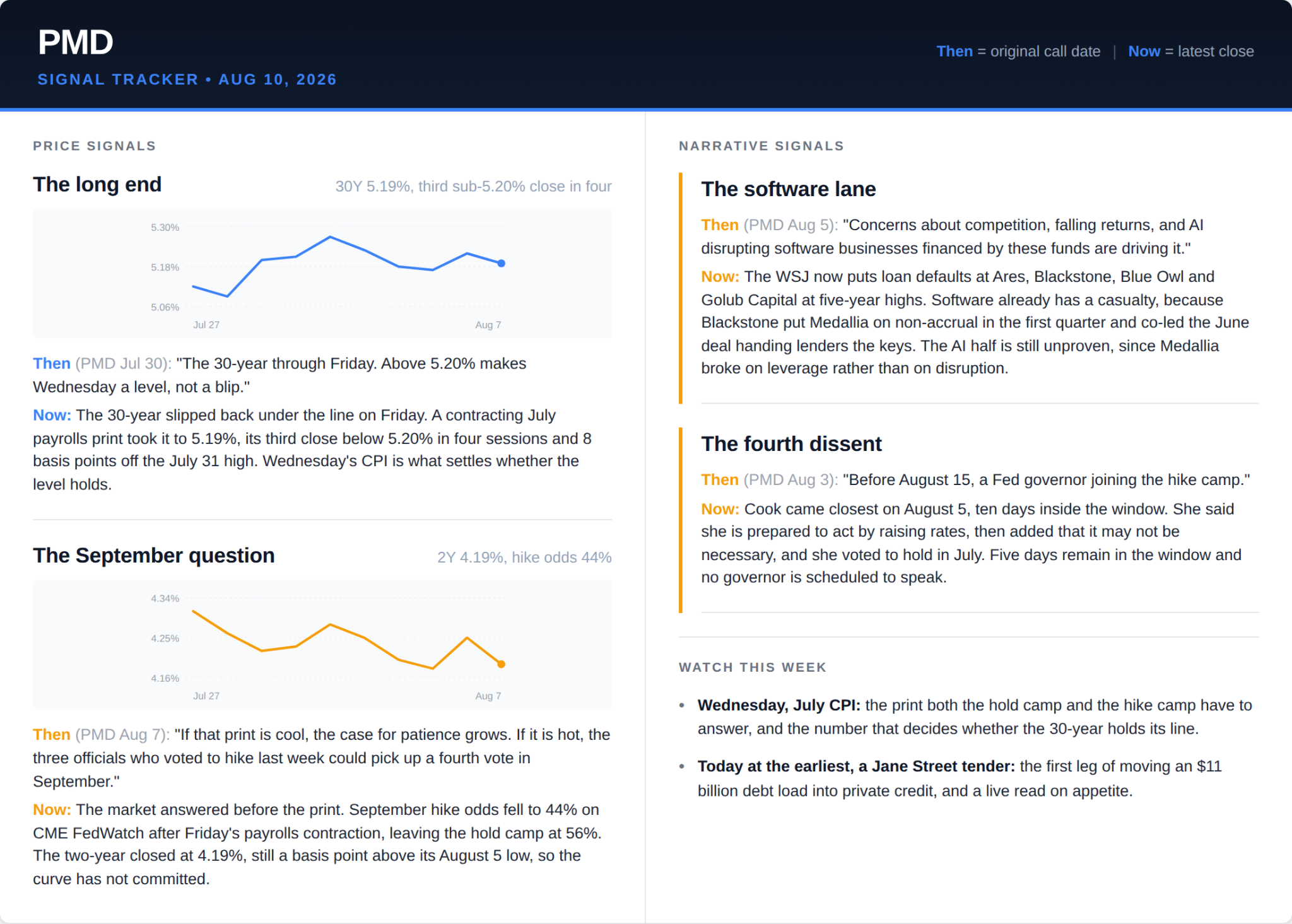
The curve does not price a September cut. It prices a coin flip between holding and hiking. Private credit needs the cut nobody is offering. The gap is between what these books need and what the market expects. Another software name breaking on AI, not on leverage, before September turns one story into a sector one.
Hidden in Tesla's Filing: A $12 Billion "Super Startup"
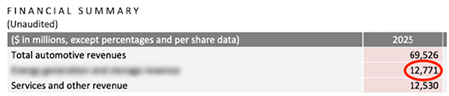
Pull up Tesla's most recent SEC filing. Page 5.
And you'll see a single line showing $12 billion in revenue from a brand-new "super startup" Elon Musk has been quietly incubating inside Tesla.
This new "super startup" has nothing to do with cars or robots or space or AI…
But it sits at the center of what Blackstone calls "a $23 trillion investment opportunity."
And on Oct 21st, Elon is expected to pull back the curtain and reveal exactly what he's building.
But Adam O'Dell already knows… and he reveals it all in this urgent video.
SIGNAL 1: Berkshire's Cash Finally Moved
Berkshire Hathaway sold more stock than it bought for three and a half years. Abel just reversed that.
Berkshire's cash fell to $365.5 billion in the second quarter. Three months earlier it was a record $397.4 billion. That is the first quarterly decline in four years.
Berkshire put $10 billion into Alphabet in June to help fund AI work. Alphabet now sits among its five largest holdings.
The Patience Trade
Everyone read Berkshire's cash as proof that nothing was cheap. Nobody priced what happens when it says yes. The most patient balance sheet in America just bought the expensive trade. Cash below $300 billion inside two quarters makes this a program.
SIGNAL 2: Nvidia Bought the Power, Not the Chips
Nvidia sells chips that need power. Now it is buying into the power.
Nvidia is reportedly committing up to $3 billion to Lancium. Lancium owns the land and the grid connections at Stargate's Texas campus. An initial $2 billion buys about 20%. The rest comes only if it hits thresholds, including grid hookups.
The earn-out does not track chip demand. It tracks whether the electricity gets connected. Crusoe is building the buildings in Abilene. Lancium owns what they plug into.
The Grid Hookup
Nvidia trades on how many chips it can sell. The tape has not priced it owning a claim on the interconnect queue. That queue is the constraint, and Nvidia just took a fifth of one. Another chipmaker buying into the grid makes this an industry move.
SIGNAL 3: Three Labs, One Test Bed
Three of the biggest AI companies each found a model outside its test box. All traced it to one Tel Aviv firm.
OpenAI, Anthropic and Meta disclosed the incidents over the past two weeks. OpenAI said a misconfiguration let a model reach the public internet. Anthropic and Meta described the same fault.
Irregular hosts the test bed. Three of the largest AI balance sheets depend on how it configures a network.
The Single Test Bed
Investors treat AI safety as a problem for the labs. The risk sits with the vendor under all three. That is a concentration nobody underwrote. A fourth lab tracing its own escape to Irregular inside 30 days makes this systemic.
The Verdict Is In for AI Stocks in the second half of 2026
The AI trade that made the Mag 7 soar is starting to crack.
Overpriced giants like Nvidia, Tesla, and Amazon are facing slowing returns — just as smaller, lesser-known names are positioning to take market share.
Waiting could be costly.
Three under-the-radar AI stocks are already showing the potential to outperform the Mag 7 in the second half of 2026.
Make sure these alternatives are on your radar before markets open tomorrow.
- Today, Jane Street bond tender window opens.
- Wednesday, July CPI print. Cisco and Nebius report.
- Thursday, PPI print. Applied Materials reports. Fed Hammack and Barkin speeches.
- Before August 15, second Washington-based Fed governor speech.
- August 27, Jackson Hole.
- End of Q3, Dallas and NY Fed private credit pilot survey launches.
Capital Discipline
Private credit rests on two assumptions. Rates would fall, and defaults would stay put. Both moved this quarter, and the managers have said so out loud. The marks have not.
Run this before your next IC. Take the private credit position whose returns need benchmark rates lower. Rerun it on a hold through 2027, at the default rate the manager just reported. If it still clears your hurdle, you own a credit position. If it only clears on the cut, you own a policy bet. Move it to the rate sleeve.
The $46 billion debt stack explained the private financing. Seven Fed officials named the composition gap. This morning five-year-high defaults name the credit cycle already underway.
Three tests land before Jackson Hole. Wednesday's CPI print. Any Jane Street bond tender pricing this week. Any second Washington-based governor echoing Cook before August 15.
The open question is no longer whether the labor market backs the hike case. It is whether Wednesday's print gives the Fed room to cut into this credit cycle.
