
THE NUMBER 46.3%.The drop in US private equity exit value last quarter, to $102.6 billion. The middle market hit its lowest reading since 2020. Hold periods reached 4.5 years, the highest in two decades. That bottleneck was open before Wednesday. Now the Fed says it isn't done raising rates. THE SETUP The Fed raised its benchmark rate a quarter point Wednesday, to 3.75% to 4%, its first hike since 2023. The vote was unanimous. New projections show most officials expect one more increase this year. Jeff Gundlach called the press conference "thin" and "opaque". He wanted a half-point move instead, "stun and done." PMD LENS A hiking cycle, not one hike, is what would actually hurt monetization, PitchBook's Kyle Walters says. The dot plot just told him it's the cycle. Most buyout debt floats. A second hike raises interest costs on the same companies sponsors are trying to sell, and weakens the numbers a buyer underwrites against. PMD SIGNAL TRACKER 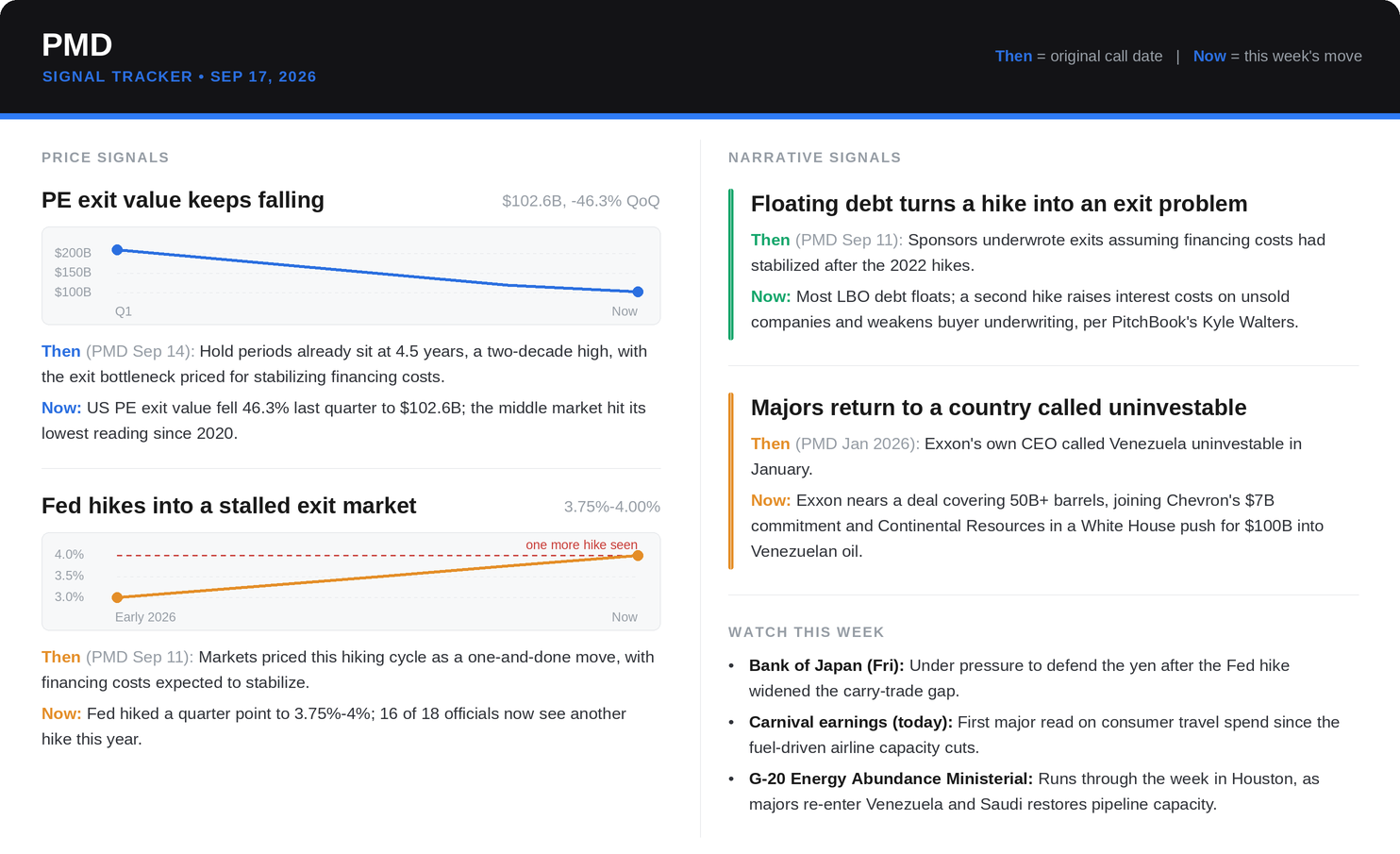
PREMIER FEATURE There's a Strategy Behind the Iran War.I know because I've seen the evidence firsthand. On March 2nd — three days after the first missiles hit — I sat across from two U.S. Congressmen in back-to-back private meetings. Those meetings pointed me toward something I spent weeks verifying. The real purpose behind the strikes. The real objective. And the single company at the dead center of all of it. This isn't random. It's a calculated Two-Front Economic War. And there's one company positioned right at the heart of it. See the strategy behind the Iran war — and the company at the center of it The sooner you understand what's really happening — the better positioned you'll be before — Dylan Jovine, Founder, Behind the Markets WHAT MOST WILL MISS - Blackstone, KKR and Energy Capital Partners are bidding for GFL Environmental (GFL). Brookfield and IFM Investors have a rival bid, in what could be one of the year's largest LBOs.
- Holtec Nuclear pulled its US IPO, citing market conditions. Standard Nuclear (down 20.6% from its offer price) and X-Energy (down 36.7%) are the two nuclear listings ahead of it, both trading well under water.
- The Bank of Japan meets Friday, under pressure to defend the yen after the Fed's hike widened the carry-trade gap.
IN FOCUS The Hawkish Hike Lands on a Private Equity Industry That Already Can't ExitPitchBook calls Wednesday's hike directionally negative for PE exits. The real bottleneck traces to 2022, when the Fed's first hikes opened a buyer-seller pricing gap that never closed. Walters named the actual question: is this hike a one-off, or the start of a cycle. "If it's the latter, that would have a more negative impact on monetization efforts, as most LBO debt is floating rate, which results in higher interest expense on these companies, and can damage the financial statements prospective buyers look at." Sixteen of eighteen Fed officials now see another hike this year. CohnReznick's Jeremy Swan put the sponsor-side cost plainly: "As deals get more expensive, exits get harder, and investors need to prepare for a shift in pricing and in exit strategy." Hold periods already sit at 4.5 years. A rate cycle does not create that liquidity constraint. It compounds one already priced into every unsold company's financing. The Exit Signal This bottleneck was priced for financing costs that stabilize, and they didn't. A GP underwriting an exit on today's floating-rate cost is underwriting against the same base case the Fed just moved, and that should hit marks and hold decisions before it ever shows up in Q3 exit data. FROM OUR PARTNERS Free Stock Pick: The Company First in Linefor America’s New Super Fuel The U.S. Army and Department of Energy are about to flip the switch on a revolutionary new fuel — and one obscure defense contractor has a five-year head start on every competitor. This joint, high-priority initiative — ordered by President Trump — is called Project Janus. And the first powerplant to run this new fuel is expected to go live before December 18, 2026… When it does, this company’s name will be everywhere. Full details — including the name and ticker symbol — are being revealed for free. 
Click HERE to get the stock name, ticker, and the full Project Janus story for free. SIGNALS IN MOTION SIGNAL 1: Airlines Are Cutting Schedules Over a Fuel Shock That Just Added $1 Billion to American's QuarterAmerican, United and Southwest are scaling back schedules as fuel costs cut into profits. American's CFO said fuel prices rose about a dollar a gallon since July, adding roughly $1 billion this quarter. United is dropping December flights and may cut more into 2027. Southwest already cut its 2026 capacity growth roughly in half. American (AAL), United (UAL) and Southwest (LUV) are all down 11% to 15% over the past month. Demand has not broken. United called its bookings "tremendously strong," with "very little evidence of demand destruction." Carriers are cutting routes where the math no longer works, not answering fewer travelers. Operational, Not Consumer Capacity, not traffic, is the number that moves first. Margin-driven cuts arrive before revenue data shows any softness, so strong bookings are not evidence the fuel shock is contained. Anyone marking airline credit or lease exposure to demand alone is reading the wrong number. SIGNAL 2: Amazon Gave Generac Warrants Worth $340 Million, Its Third Supplier Stake in WeeksGenerac (GNRC) jumped more than 40% after hours after Amazon (AMZN) got warrants to buy up to $340 million of its stock. Generac will supply backup generators for Amazon's data centers, with $2.4 billion in deliveries due in 2027 and 2028. It is Amazon's third such stake in weeks, after a larger deal with Qualcomm worth up to $4 billion. The same week, the House passed the Ratepayer Protection Act 417 to 3. It requires data centers over 100 megawatts to cover their own power costs, not ratepayers. Power, Not Chips Amazon is financing power with warrants, not utility contracts, and that shifts the equity upside in power buildout from regulated utilities to hyperscaler cap tables. That is new competition for any private capital allocated to power-adjacent suppliers, arriving the same week Congress tried to keep that cost off ratepayers instead. SIGNAL 3: Exxon Is Nearing a Return to Venezuela, Joining an Industry Rush Back InExxon (XOM) is close to a preliminary deal to explore Venezuelan oil fields it left nearly two decades ago, a deal that could cover more than 50 billion barrels. It follows Chevron's (CVX) $7 billion commitment this month and a preliminary deal this week from Continental Resources, part of a White House push to put $100 billion into Venezuela's oil sector. Exxon's own CEO called the country uninvestable in January. Venezuela has since rewritten its oil laws to draw the majors back. Separately, Saudi Arabia is restoring about half its East-West pipeline within days after drone attacks forced a shutdown, with full capacity due in about six weeks. A Multi-Year Bet Capital reveals a duration call that price alone can't. Nobody signs a nineteen-year commitment against a shock it expects to fade, so any portfolio still marked to a transient premium is underwriting against the industry's own revealed view, not just this week's price. PARTNER SPOTLIGHT Take a look at this… It's a radical "light-speed" device that's turning AI as we know it into "Accelerated AI", making it 100 times faster and 100 times more energy efficient. In fact, Jensen Huang, Nvidia's founder and CEO, says this device is shattering the limitations of AI and without it, AI can't scale. If you want to discover what this technology is, why Nvidia is betting billions on it… And the one stock we believe could be the biggest winner when "Accelerated AI" goes mainstream… Click here to see all the details. THE PLAYBOOK The Bank of Japan decides Friday. Carnival reports today. The G-20 Energy Abundance Ministerial runs through the week in Houston. CAPITAL DISCIPLINE Two assumptions carry more weight than the evidence supports. That an LBO's exit math holds through a hiking cycle, when most of that debt floats and a second hike is now the base case. That strong bookings mean airlines are absorbing the fuel shock, when American just took a $1 billion hit. PMD REPOSITION Wednesday's quarter point is small next to what it confirms. Rates are going higher again, and the industry least able to absorb that already has the longest hold periods and thinnest exit market in years. The same hike raising financing costs on unsold companies is also cutting flights and pushing majors back into oil fields they once left. None of it reverses on its own. It waits on the next data point, the one the Fed's own dot plot already flagged. FREE FINANCIALMARKETS.COM ALERTS The Next Market Move Could Start With One Alert Get breaking market developments, trade ideas, analyst signals and upcoming catalysts sent directly to your phone. Markets move quickly. Now your information can too. START GETTING FREE ALERTS → |