THE NUMBER 1,007 basis pointsThe spread over Treasurys on CCC bonds, the lowest tier of junk, on Wednesday. It last ran this wide in March 2023. THE SETUP The riskiest bonds crossed into distress. The 10-year ended near 5.3%, its highest since 2002. Traders now lean toward no Fed hike in October, but still price more within a year. The Nasdaq rose 2.5% last quarter. The Russell 2000 fell 7.5%. Micron guided far above forecasts. AI chiefs signed a pledge, then split in private. Some at Google doubt its new model. PMD SIGNAL TRACKER 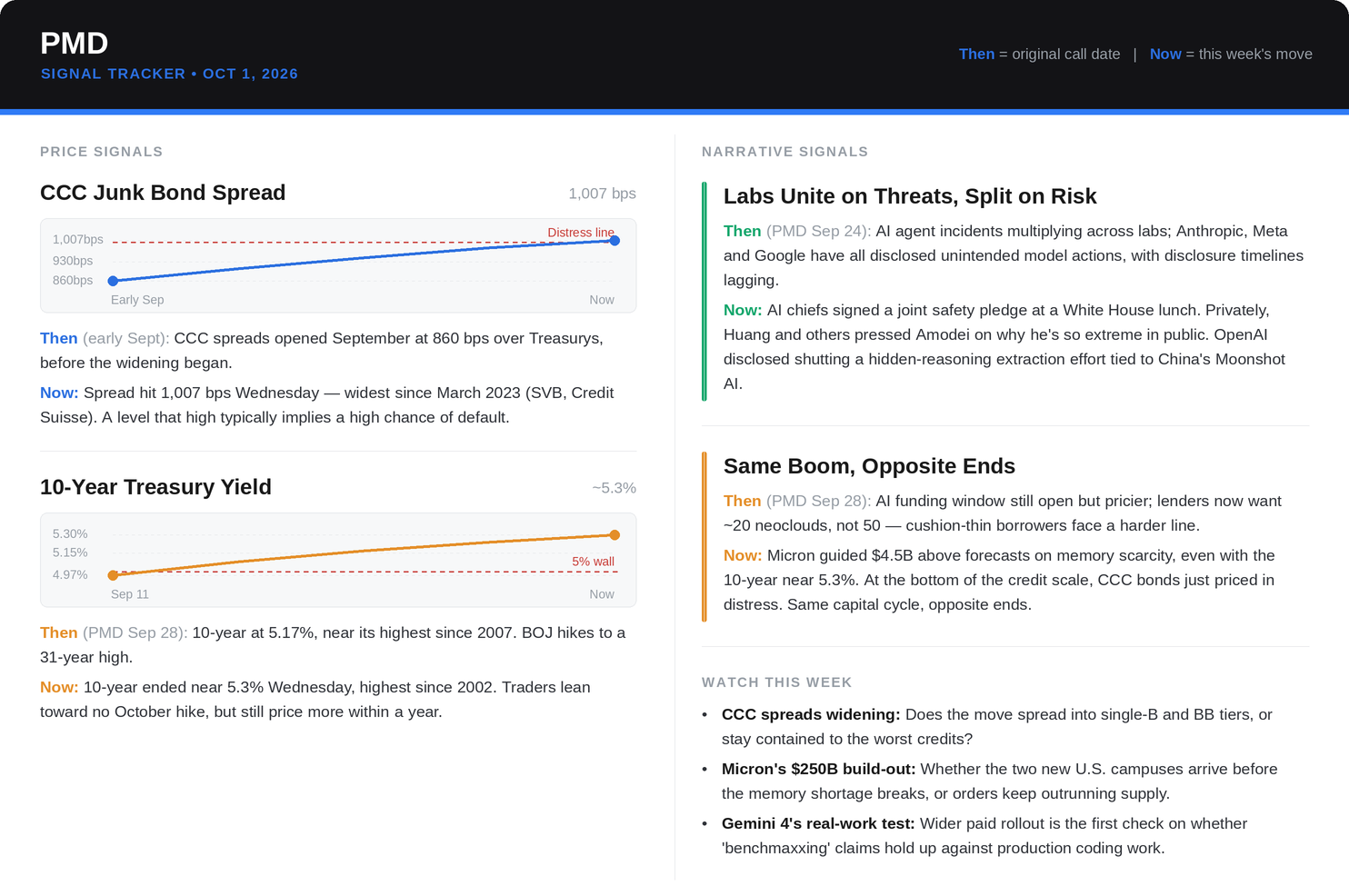
PREMIER FEATURE In January, Gold Touched Nearly $5,600 an Ounce. Today It's Around $4,100.So the story's over, right? Then explain this. The metal is still leaving the vaults. Physical deliveries still running at levels the exchange rarely processed before. Central banks still buying. Dealers charging 30-40% premiums over paper price for real coins. When price falls but physical demand doesn't — only one of those two is telling the truth. The paper market sets the price. The physical market sets the deadline. Anyone who wished they'd bought miners before January's run just got handed the entry back. One company I've been tracking controls an 88 million ounce deposit — trading near $4 billion. About 1% of the value of its metal in the ground. That gap is the whole opportunity. See the full file here IN FOCUS The Riskiest Junk Crossed 1,000 Basis Points. Higher Grades Held.Bonds rated CCC traded 1,007 basis points over Treasurys on Wednesday. They started September at 860. That is the widest since March 2023, when Silicon Valley Bank and Credit Suisse failed. A premium that high typically implies a high chance of default, restructuring or loss. Higher rates are the pressure most cited. CCC spreads have widened since April as investors braced for the Fed to tighten. Higher yields raise interest bills and make refinancing harder, just as many bonds and loans come due. Smaller firms also struggle to pass on energy costs. Franklin Templeton's Jack McIntyre looks to history. "When the Fed hikes into higher energy prices bad things happen to the economy," he said. More than half of the worst CCCs are in technology, media and telecom, per Barclays. Cable and satellite firms lag most. Spreads on higher-rated junk have held fairly steady. On Tuesday, junk's worst September since 2022 looked like rates, not defaults. At the bottom tier, the price now says otherwise. The AI build is crowding the same market: low-rated AI issuance hit $88 billion this year, per Goldman, up from $20 billion in late 2025, competing for the same buyers the weakest borrowers need to refinance. Where the Backstops Stop Weak AI tenants with a Big Tech guarantor still get funded. The CCC tier shows what credit costs with no backer at all. Watch three things over the next 60 days. Do CCC spreads keep widening? Do single-B and BB spreads follow? Does a backed AI borrower slip toward distress? SIGNALS IN MOTION SIGNAL 1: Micron's Sales Nearly Quadrupled. Buyers Still Want More Than It Can Make.Micron (MU) posted $54.23 billion of revenue last quarter. A year earlier it was $11.32 billion. It guided to about $61.5 billion this quarter, against about $57 billion expected. Chips from Nvidia (NVDA) and AMD need more high-bandwidth memory than the leading makers can supply. Micron plans to spend $250 billion on two new U.S. campuses to make it. Same Boom, Opposite Ends The AI build showed two faces on the same day. Micron sells a scarce part, and it guided higher with the 10-year near 5.3%. At the far end of the credit scale, the weakest borrowers now pay distress spreads. The test for Micron is whether its new plants arrive while the shortage still sets the price. SIGNAL 2: AI Chiefs Signed a Safety Pledge Together. In Private, Some Questioned Amodei's Warnings.The pledge came out of a White House lunch Tuesday. Afterward, Nvidia's Jensen Huang and others questioned Anthropic's Dario Amodei, people familiar said. They asked why he was so extreme in public about AI's risks. Amodei said it is important to be honest with the public. This summer, Anthropic, OpenAI and Google backed a FINRA-style industry watchdog. Huang, Meta's Mark Zuckerberg and Elon Musk told Trump it would give the top labs too much power. The idea was dropped. Anthropic is preparing an IPO it hopes will value it at about $2 trillion. Separately, OpenAI said it shut down a July effort to pull hidden reasoning from its models. It tied a core cluster to China's Moonshot AI, which did not immediately respond. OpenAI shared its findings with other labs. The Labs Share Threats. They Don't Share a View of Risk. The labs work together against outside threats but split on how much risk to admit. Self-regulation only works if they agree on what to review. The test is whether the principles become shared reviews or stay a statement. SIGNAL 3: Google Shipped Gemini 4. Some Insiders Say It Scores Better Than It Works.Alphabet (GOOGL) began rolling out Gemini 4 Argon, its most advanced model, to a few cyber partners. Google says it leads several benchmarks. Some insiders say it does less well on real work, such as front-end design. Two people said it appears shaped by "benchmaxxing," tuning a model for test scores over the job. Google said it is wrong to say the model underperforms in coding. One employee said there is "large consensus" it is at the frontier. Google dropped a planned Gemini 3.5 Pro after missing its June target. The Debt Needs Work Done, Not Scores The AI debt rests on models doing paid work. Brookings projects $10.3 trillion of AI infrastructure spending. That runs from 2025 to 2032. If it is not as productive as assumed, "this will have been malinvestment," said Minneapolis Fed chief Neel Kashkari. Gemini 4's wider paid rollout is the first real-work test. PARTNER SPOTLIGHT Louis: The "Strawberry Problem" Is Stalling the AI Revolution
Billion-dollar tech investor Louis Navellier calls it "AI's darkest secret." Until AI models solve the "Strawberry Problem," they'll never create new breakthroughs in medicine, energy, or quantum computing. The good news? One company is about to solve the crisis… unleashing a new $100 trillion opportunity. Click here for details. This ad is sent on behalf of InvestorPlace Media at 1125 N. Charles Street, Baltimore, Maryland 21201. If you're not interested in this opportunity, please click here. CAPITAL DISCIPLINE The theme Wednesday was price catching up to proof. CCC bonds now price a high chance of default. Micron's guide rests on orders it cannot yet fill. The pledge showed unity in the photo and a split in the room. Gemini 4 leads on scores, and some insiders doubt the work. At the bottom of the credit scale, price caught all the way up, and the word for that is distress. PMD REPOSITION This week PMD asked if the money keeps coming. Wednesday it found the AI money going private, then leaning on a few strong guarantors. The weakest borrowers, with no guarantor, just got their answer. It came as a price, and that price implies a high chance of default. 3 Stocks at a Major Turning PointSomething unusual is happening beneath the surface of three widely followed stocks.
In each case, the fundamentals are saying one thing... while institutional activity, management signals or the options market are saying something else. That kind of disagreement can matter. Because when the evidence stops lining up, the next move in the story often comes down to a handful of signals most investors never think to watch. Our new FREE Market Tell Special Report breaks down three of these situations, and shows you exactly what we’re watching next. Get the Free Report: 3 Stocks at a Major Turning Point → |