

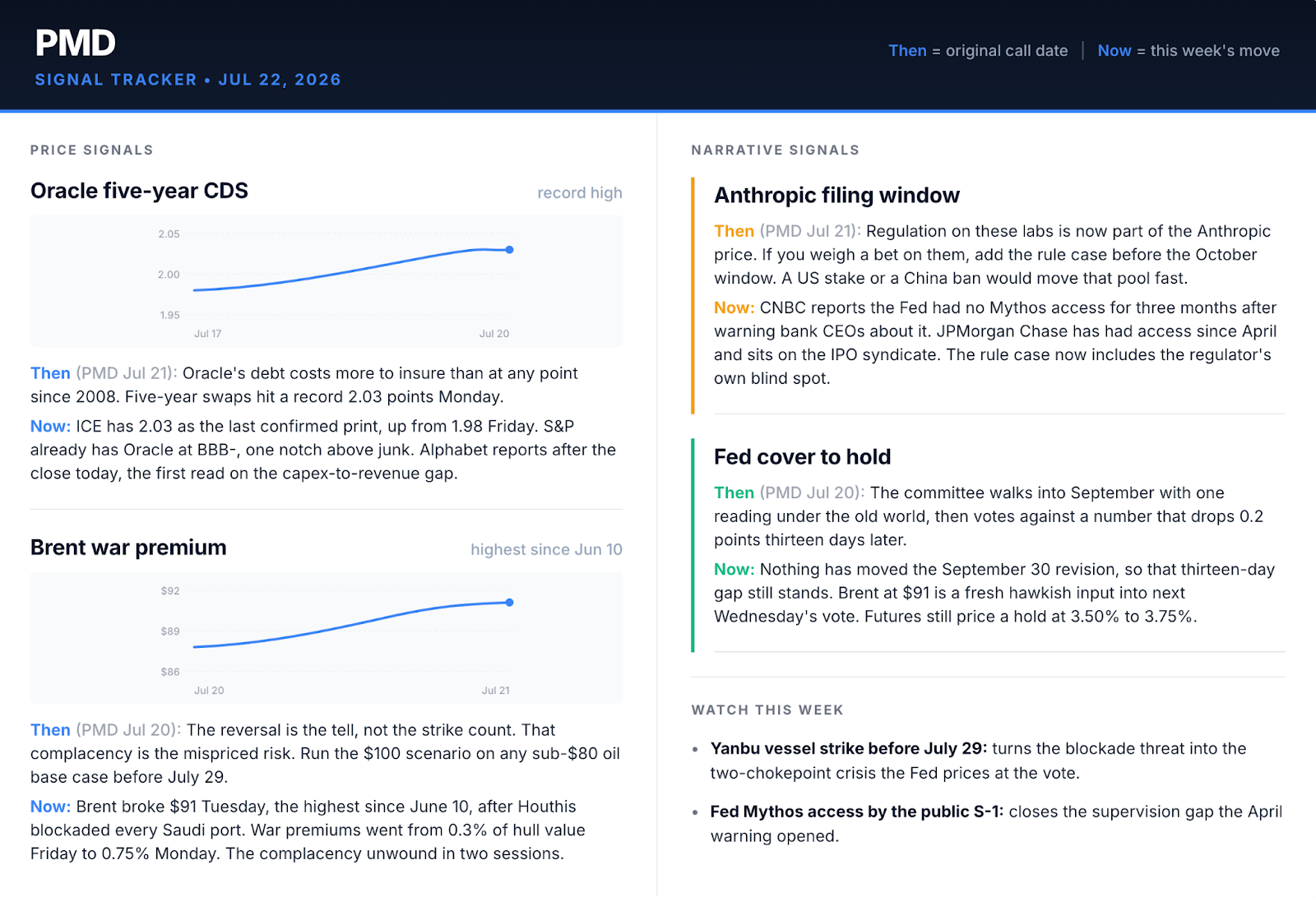
The Fed convened bank CEOs in April to warn about Anthropic's Mythos model and still cannot get access, Houthis have blockaded every Saudi port, and zombie private-equity funds just hit a record $348.5 billion.

Three.
The months the Fed has been asking for access to Anthropic's Claude Mythos Preview model, after it called in bank CEOs to warn them about the cybersecurity threat. It still does not have it.
CNBC reports the Fed and Treasury called in top bank CEOs in April.
The warning was about Claude Mythos Preview. For three months after, the Fed itself had no access. Warsh confirmed it last week.
MarketWatch reports Yemeni Houthis told shipping firms Tuesday to avoid all Saudi ports. Brent broke $91. That is the highest since June 10.
The Wall Street Journal reports Trump approved a 30-year Saudi nuclear deal. It opens the door to uranium enrichment.
Private-equity money trapped in decade-old funds hit a record $348.5 billion.
PMD LENS
Yesterday's PMD tracked Bessent threatening sanctions on Chinese labs. His evidence was Anthropic's Senate letter. Today the frame turns inward. The American central bank cannot get the American model the Treasury Secretary is out defending. It sits exposed to a threat its supervised banks are already patching.
The Market Is Going to Crash And You Are Unprepared.
The problem isn't your investments — it's that you're making one giant directional bet on the market staying up.
A passive portfolio layer of 12 uncorrelated algorithms that profit from market movement, not market direction — and that has historically outperformed the S&P by roughly 5x since 2020.
Discover the algorithms that capitalize on market crashes for you.
- Anthropic briefed the cyber agency and the AI standards center. The central bank was not.
- June's export order switched Mythos 5 and Fable 5 off. Commerce restored it for trusted partners.
- War premiums on Saudi routes went from 0.3% of hull value Friday to 0.75% Monday.
- Strikes on the Caspian Pipeline terminal cut Kazakh exports. A third supply shock nobody counts.
- Tail assets historically return 53 cents on the dollar. Against $348.5 billion, $164 billion lacks a buyer.
The Fed Rang the Alarm in April. It Still Doesn't Have the Model.
The April Meeting
In April the Fed and Treasury called in the largest US bank chiefs. Anthropic had built a model unusually good at finding software flaws. It handed Claude Mythos Preview to roughly 50 organizations under Project Glasswing. JPMorgan Chase (JPM) was one. The Fed was not.
The Access Gap
The regulator of those banks had no access to the model it warned about. That warning came under Jerome Powell. Warsh inherited the gap. He told the Senate last week he is still asking. The Fed, he said, is "not the deciders as to who has access."
The Underwriter
One more piece nobody has joined up. JPMorgan Chase has had access since April. It is also on the syndicate taking Anthropic public. One bank holds the tool, sells the offering, and prices the exposure. Its regulator holds none of it.
The Mythos Signal
Your AI positions assume a supervisor who can see the technology. At the Fed it does not. Pull anything leaning on regulators keeping pace with the labs. Anthropic's public S-1 comes next. Ask your GP one thing. Does that underwriting price a regulator three months behind? If it needs a current one, you own a supervision bet.
The Verdict Is In for AI Stocks in the second half of 2026
The AI trade that made the Mag 7 soar is starting to crack.
Overpriced giants like Nvidia, Tesla, and Amazon are facing slowing returns — just as smaller, lesser-known names are positioning to take market share.
Waiting could be costly.
Three under-the-radar AI stocks are already showing the potential to outperform the Mag 7 in the second half of 2026.
Make sure these alternatives are on your radar before markets open tomorrow.
SIGNAL 1: Houthis Just Blockaded Every Saudi Port
Yemen's Houthis emailed shipping companies Tuesday. Stay out of Saudi ports. Ships that call may be hit. Saudi Arabia had been routing about 4 million barrels a day through Yanbu. That was the workaround after Hormuz traffic collapsed. Now the workaround is contested too. At least five tankers have turned around.
SIGNAL 2: The Insurance Repricing Test
Freight and insurance repriced first, doubling inside a weekend. That channel sits outside most models. If you hold shipping, logistics, or seaborne inputs, rerun freight at double the war premium. If margins clear, the exposure is small. If not, you carry a route bet.
SIGNAL 3: Trump Just Approved a 30-Year Saudi Nuclear Deal
Trump signed off on a civilian nuclear program for Saudi Arabia. It runs 30 years, worth tens of billions. American firms lead, rivals are shut out. One clause would let US companies build a uranium enrichment plant there. The UAE gave up enrichment to get its US nuclear deal. This breaks that template.
SIGNAL 4: The Thirty-Year Counterparty Check
Underneath the politics this is contracted infrastructure. Sovereign counterparty, no competing bid. Infra funds underwrite those at premium multiples. The kingdom won a reactor the same week its ports went dark. Test Gulf exposure against a political repricing this quarter. If the return needs today's multiple, you own a regime bet.
SIGNAL 5: Zombie Funds Just Hit a Record $348.5 Billion
Money trapped in funds at least ten years old hit $348.5 billion at end-2025. That is 3.5 times the 2015 level. Behind it sits another $512.7 billion in funds aged seven to nine. Preqin puts unsold portfolio companies at $3.91 trillion. That locks up 74% of North American private-equity assets.
SIGNAL 6: The Distribution Assumption
Yesterday's PMD tracked a forced seller in Oracle credit. Nobody makes these funds sell. Nobody offers to buy either. Not a forced seller, but a forced holder. On every fund you hold, check the vintage. Anything from 2014 through 2016 still holding assets is telling you something. Ask why. Ask for a dated exit path, not a mark.
Could the AI Boom End Like the Dot-Com Bubble?
But one market statistic — praised by Warren Buffett as the best measure of valuations — is now flashing a historic warning.
It’s currently higher than it was at the peak of the Dot-Com Bubble.
If the signal proves accurate, the coming AI unwind could shake the entire market.
See the alarming stat — and what investors should do before the next crash unfolds.
- Fed confirms Mythos access by the public S-1: supervision gap closes.
- A Glasswing bank names patched weaknesses on Q2: two-tier defense confirmed.
- A strike on a vessel leaving Yanbu before the July 29 Fed decision: threat becomes crisis.
- War premiums above 1% of hull value: freight lands in Q3 shipper margins.
- A mid-2010s fund winding down this quarter: holding becomes forced selling.
Capital Discipline
The Federal Reserve has been asking Anthropic for three months to access a model its own chair calls a systemic cybersecurity threat. The Treasury Secretary is publicly defending Anthropic against Chinese labs while the American central bank goes without the American tool. Anthropic files publicly for October inside that gap. The Fed is a supervisor working blind on a model its underwriters have had since April. That is the structural fact underneath the IPO, and it is not in any prospectus.
Watch the Fed on Mythos access. Watch the war premium on Saudi routes. Watch your oldest fund's vintage.
One question sits under all three. Who is on the other side? The Fed warned banks about a tool it cannot use. Saudi Arabia built a route it cannot insure. Private equity holds assets it cannot sell.
Anthropic's public S-1 arrives ahead of the October window. That filing puts the first price on the gap.
